

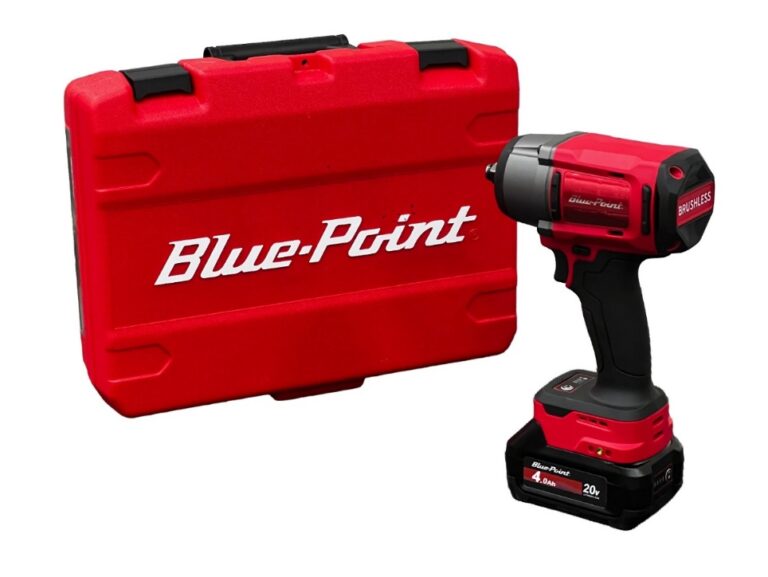
Blue-Point BLP20BIW900C1 20V Brushless Cordless Impact Wrench 900 N·m Kit FAQ
What fasteners and real-world jobs can the BLP20BIW900C1 handle with up to 900 N·m of torque?
A 900 N·m impact wrench is intended for heavy-duty fastening and removal tasks, but actual removal capability depends on fastener grade, corrosion, thread condition, previous tightening torque and joint design. The following examples are practical references rather than universal torque limits.
|
Work category |
Typical application |
Common fastener reference |
Practical capability |
|
Automotive |
Passenger-car and SUV wheel fasteners |
M12 × 1.5; M14 × 1.5 |
Well suited to routine removal and installation. Typical specified wheel torque is often around 80–120 N·m, but always follow the vehicle manufacturer’s torque specification. |
|
Automotive |
Commercial-vehicle and light-truck wheel fasteners |
M22 × 1.5; M24 × 1.5 |
Can cover many applications. Severely corroded or very high-preload fasteners, including those above roughly 800 N·m, may require penetrating lubricant or a higher-capacity method. |
|
Automotive |
Suspension and chassis fasteners |
M14–M20 |
Suitable for many common chassis connection bolts and routine service operations. |
|
Heavy equipment |
Construction-equipment track plates and attachment bolts |
M20–M24 |
Suitable for routine maintenance and removal. Efficiency may decrease on high-strength, larger-diameter fasteners such as M30+ or on long-neglected joints. |
|
Heavy equipment |
Drivetrain and agricultural-equipment fasteners |
M16–M22 |
Useful for routine agricultural and construction-equipment maintenance. |
|
Steel structure |
Large hex-head structural fasteners |
M20; M22; M24 |
Can support initial tightening and some final-tightening tasks. Required torque must be set according to fastener grade, such as 8.8S or 10.9S, and the applicable construction specification. |
For removal, begin with the lowest suitable setting and increase only as necessary. For final tightening of critical fasteners, use the specified procedure and a calibrated torque tool where required; impact-wrench output is not a substitute for the manufacturer’s or engineering specification.
What are the practical advantages of the brushless motor and automatic control functions compared with a conventional impact wrench?
BRUSHLESS MOTOR
· Lower maintenance: because there are no carbon brushes to wear and replace, routine motor maintenance and downtime can be reduced compared with a brushed motor.
· Efficiency and runtime: lower internal friction helps improve electrical efficiency, supporting longer working time from the battery during repeated fastening tasks.
· Compactness and noise: the brushless motor design allows a compact motor package and can operate with less mechanical noise than a conventional brushed design.
AUTOMATIC / INTELLIGENT CONTROL
· Tightening auto-stop: the electronic control system stops power at the programmed threshold to reduce the risk of excessive tightening that could damage threads or break fasteners, particularly on more sensitive components.
· Controlled loosening: during removal, the tool applies impact force to break the fastener loose and then reduces speed after release, helping prevent the fastener from spinning out suddenly at full speed.
These functions are intended to make repetitive fastening more controlled. They do not replace the specified final-torque procedure for safety-critical fasteners.
How does the BLP20BIW900C1 perform during repeated heavy-duty work or in dark work areas?
· Heat management: an internal airflow cooling design helps remove heat from the motor area. During repeated bolt removal and installation, this can slow temperature build-up and help the tool maintain performance for longer before thermal protection or heat-related power reduction becomes a concern.
· Visibility: two front LED lights are positioned on both sides of the impact-wrench head so the light is directed toward the socket and fastener area. This helps reduce shadows caused by the user’s hands or the tool body in engine bays, under vehicles and during low-light work.
· Operator comfort: the TPE overmoulded handle provides a more secure, cushioned grip with anti-slip texture and vibration isolation, helping reduce hand fatigue during longer periods of use.